 Professor Franklin
Chapter 18 · Reading 3 of 3
From wallet to person
CHFI domains 1, 4, 5, 6
The test purchase paid the marketplace’s deposit address bc1q…k7m4. From there the investigators want to reach a person, and the path runs through three different kinds of evidence. Each can be strong for one link and silent about the next, so the chapter’s exhibit map records what supports every link and where it stops.
Three separate claims
Cryptocurrency cases blur three claims that the report keeps apart:
Clustering and its limits
Blockchain analysis tools group addresses into clusters that probably belong to one entity. The best-known rule is the common-input-ownership heuristic: when one transaction spends inputs from several addresses, a single wallet probably signed them all. Change detection adds more addresses. Applied repeatedly, these rules put bc1q…k7m4 in a cluster of 212 addresses, labeled MK-3, that collected deposits for the marketplace.
A cluster is an inference, not an observation. CoinJoin transactions deliberately combine inputs from unrelated users and break the heuristic, and a wrongly identified change output can merge two owners. Commercial tools such as Chainalysis Reactor and TRM Labs apply their own heuristics and attribution labels, which an examiner reports as the vendor’s conclusions, naming the tool and version, rather than as facts.
Exchanges hold the identities
Most people buy and sell cryptocurrency through exchanges, which must collect identity documents under know-your-customer (KYC) rules. With legal process, an exchange can provide an account holder’s identity, login IP addresses, linked bank accounts and the deposit addresses it assigned to the customer. Here, the exchange’s records show that an account verified in the supervisor’s name received 0.41 BTC in eleven deposits, all traced back to cluster MK-3.
That is a payment from the marketplace’s cluster to an account in the supervisor’s name. It is consistent with a vendor cashing out sales, and also with a refund, a payment for some other service, or an account someone else opened with the supervisor’s identity. The login IP addresses and bank withdrawals help test those alternatives.
The seized hardware wallet
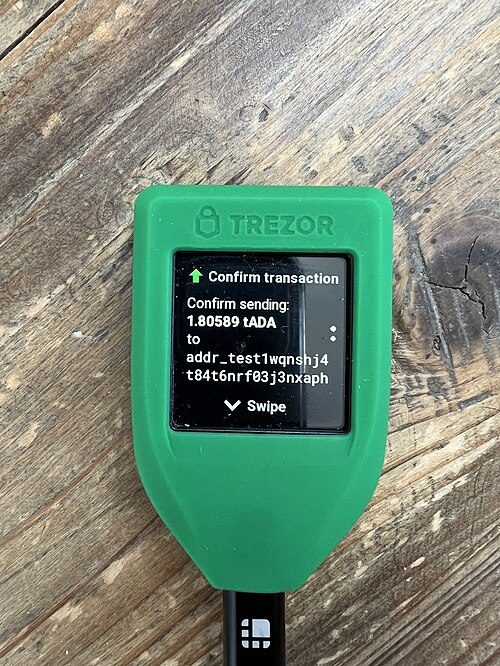

A hardware wallet stores private keys on a dedicated device and signs transactions without exposing them. Its keys are generated from a seed phrase, usually 12 or 24 words under the BIP-39 standard, and every address the wallet uses is derived from that seed in a fixed order. Whoever has the seed can rebuild the wallet on any device, so a seed phrase written on paper is itself critical evidence, and an asset that someone else could move at any time.
Examiners do not guess PINs on a hardware wallet: many models wipe themselves after a set number of failed attempts. In this case the PIN was written on a card in the supervisor’s desk. With a warrant covering the device, the examiner connected it to an isolated workstation and, without signing any transaction, displayed its receiving addresses. Address index 7 matched bc1q…k7m4. The examiner recorded the session on video and noted the balance. Seizing the funds themselves follows a separate procedure, with the agency’s own wallet and two people present.
| Link | Independent support | Limitation |
|---|---|---|
| Listing offers the stolen lot | Investigators’ own capture with hashes; lot number CX2291 | Listing does not prove the goods exist |
| Test payment reached the marketplace | Public ledger, 41 confirmations; buyer’s wallet log | None for the payment itself |
| Deposit address belongs to cluster MK-3 | Common-input and change heuristics, tool and version recorded | Inference; CoinJoin could merge owners |
| Seized device controls bc1q…k7m4 | Address derived at index 7, recorded on video | Shows control by the device, not its user |
| Supervisor used the device | Found in the supervisor’s desk with the PIN; exchange account in the supervisor’s name; onion address in the laptop’s hibernation file | Others with access to the home; tested against alibi and video from 24 November |
On the exam, a transaction, control of an address and the identity of a person are separate claims, clustering is a heuristic, exchanges supply identity under legal process, and a hardware wallet proves control without proving who held it. The next chapter, Forensic automation and tool validation, checks whether the tools behind findings like these give the right answers.
Inspect the three records, then use the evidence to answer the question.
1. Clustering
bc1q…k7m4 grouped with 212 addresses by common inputs
2. Exchange
KYC account of the supervisor received 0.41 BTC from cluster MK-3
3. Seized wallet
With the recovered PIN, the device derives bc1q…k7m4 at index 7
Apply the reading
An exchange’s records show that a verified customer withdrew bitcoin to an address in the marketplace cluster. Does that prove the customer ran the listing?
Compare your reasoning
No. It shows that the customer’s account sent funds to that cluster, which a buyer would also do. Running the listing needs other support, such as control of the vendor’s keys, the vendor’s PGP key on the customer’s devices, or the marketplace’s own records.